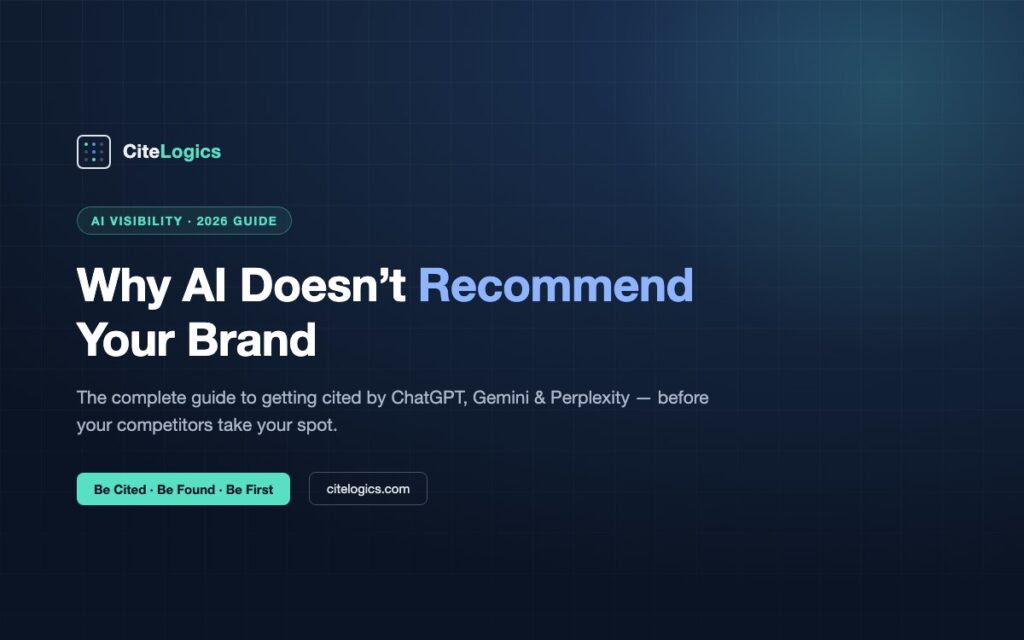
TL;DR: When customers ask ChatGPT or Perplexity for a recommendation, AI answers with specific brand names. If yours isn’t on that list, the model is quietly handing buyers to your competitors — before anyone reaches your website. This guide covers why AI overlooks your brand and the exact signals that earn a citation. See where you stand first: run a free AI visibility scan.
What “AI doesn’t know your brand” really means
It rarely means AI has never seen your name. It means that when someone asks a buying question in your category, the model doesn’t retrieve or cite you — so you never make it into the answer.
Search has split into two systems. Traditional Google shows a list of links you can climb with SEO. AI assistants read the web, write one answer, and name a handful of brands inside it. There is no page two here. You are either in the answer or you are invisible.
Why getting cited by AI matters now
1. Search traffic is moving to AI chat
Gartner projects a 25% drop in traditional Google traffic by the end of 2026 as users shift to AI chat. The audience isn’t shrinking — it’s changing where it asks.
2. Most answers end without a click
SparkToro data shows roughly 60% of searches now end without anyone clicking through to a website. If AI doesn’t mention you inside its answer, that visit never happens.
3. AI referrals convert far better
Adobe Analytics found visitors arriving from AI search convert at about 4.4x the rate of traditional Google search. The traffic is smaller but the intent is stronger — these people already received a recommendation.
4. The window is still open in Thailand
By CiteLogics’ own research, only about 0.1% of Thai websites are structured for AI crawlers. Early movers reserve space in the model’s memory before the category fills up.
GEO vs SEO — what actually changes
| SEO | GEO | |
|---|---|---|
| Goal | Rank on page 1 of Google | Be the brand AI cites in its answer |
| Unit of success | Position and clicks | Mentions and citations |
| What it optimizes | Keywords, backlinks | Structured data, entities, third-party citations |
| Where you appear | Search results page | Inside AI-generated answers |
| How you measure | Ranking, organic traffic | Recommendation rate across ChatGPT, Gemini, Perplexity, Claude |
SEO and GEO aren’t rivals. A site with solid SEO foundations is easier for AI to read. Ranking on Google, though, no longer guarantees the model names you.
How to get AI to recommend your brand
Step 1 — Audit what AI sees today
- Ask ChatGPT, Gemini, Perplexity and Claude the buying questions your customers actually use (“best [category] in [city]”).
- Record whether you appear, where you sit in the list, and which competitors get named instead.
Step 2 — Make your site machine-readable
- Add structured data in JSON-LD: Organization, Product or Service, and FAQPage.
- Fix the crawl basics: robots.txt, sitemap, canonical tags, and allow AI bots through.
- Write with clear headings, comparison tables and FAQs — the formats AI lifts most often.
Step 3 — Build citations AI trusts
- Earn mentions on independent sources: industry roundups, review sites, reputable media, and Wikipedia or Wikidata where relevant.
- State plainly, everywhere, who you serve and what makes you different — so the model can place you in an answer in one clean sentence.
Caution: No one can guarantee a fixed position inside ChatGPT — the algorithms shift monthly. Anyone promising a locked ranking is selling a promise they can’t keep. What you can control are the structural signals that make you citable in the first place.
What to look for in an AI visibility approach
1. It gives you a measurable score
Ask for a number you can track over time and benchmark against competitors, not a vague “AI ranking” no one can verify.
2. It separates diagnosis from fixes
Know your gaps before spending on fixes. A clear audit shows which of the five dimensions — crawlability, content understandability, citation presence, technical performance, AI Overview presence — is holding you back.
3. It’s honest about ceilings
Some CMS platforms cap how far you can go. A partner worth hiring tells you the practical maximum for your setup instead of overpromising a perfect score.
CiteLogics — for business owners worried AI is skipping their brand
CiteLogics runs an AI Visibility Audit that scores your site across five measurable dimensions (the AIVS Score) and hands you a step-by-step WebFix roadmap. You find out exactly why AI isn’t citing you and what to fix.
- AI Visibility Audit — full report, AIVS Score, 3-phase fix roadmap and a 30-minute call. THB 2,000, delivered in 24 hours.
- Big Win (Audit + WebFix) — full implementation, schema deployment, and a re-audit with score comparison. THB 20,000.
- Monthly Partnership — ongoing audit, tracking and 4-8 AI-citable articles per month. THB 18,000/mo.
Start with a free AI visibility scan, or reach the team at sales@citelogics.com.
Frequently asked questions
Why does ChatGPT recommend my competitor and not me?
Because the model learned about them from more sources it trusts — roundups, reviews and reputable media — not because their product is better. Recommendations track how well-documented you are across the web, not product quality.
I already do SEO. Why doesn’t AI mention me?
SEO gets you ranked on Google. AI looks for structured signals — schema, clear entities, third-party citations and FAQ formatting. Strong SEO helps AI read you, but it doesn’t guarantee a citation.
How do I check whether AI knows my brand?
Ask ChatGPT, Gemini, Perplexity and Claude the buying questions your customers use, and see if you’re named, where you land, and against which competitors. A structured audit turns that into a score you can track.
How long until AI recommends me?
Retrieval-based engines like Perplexity, Gemini and ChatGPT with search can update within days to weeks once fresh citations exist. Training-based models take longer. No one can promise a fixed position.
Can I pay to appear in AI answers?
Not in organic answers. ChatGPT’s paid placements sit separately from organic recommendations — you can’t pay the model to change what it recommends. The real lever is structural signals and trusted citations.
Related reading
Why ChatGPT Recommends Your Competitor Instead of You →
How to Check Whether AI Knows Your Brand →
GEO vs SEO — Why AI Ignores Ranked Sites →
How to Get AI to Recommend Your Brand — 7 Steps →
Can ChatGPT See My Website? How to Check →
llms.txt — What It Is and Whether It Actually Works →
How to Get Cited in AI Overviews →
How to Rank in ChatGPT — 5 Deciding Factors →
We Tested Whether AI Recommends Us — and Scored Zero →
The AIVS Score — Full Rubric and All Five Weights →
What an AI Visibility Audit Should Cost →
Seven Questions to Ask Before You Sign →
The 93 Questions We Measure AI Visibility With →
1,317 Sites Scanned — 88% Failed the AI Test →
Your Site Builder Has a Ceiling — One Case Hit 72 →

Written by
Nipun Kasevayuth
Founder & CTO, CiteLogics
An engineer and AI enthusiast who reverse-engineers how AI models decide which brands to cite. He proved the method on his own websites first — then delivered the same results for brands like Coldtubb. He and the CiteLogics team have scanned 1,000+ websites for AI visibility.
Connect on LinkedIn →