← Part of the full guide: Why AI Doesn’t Recommend Your Brand
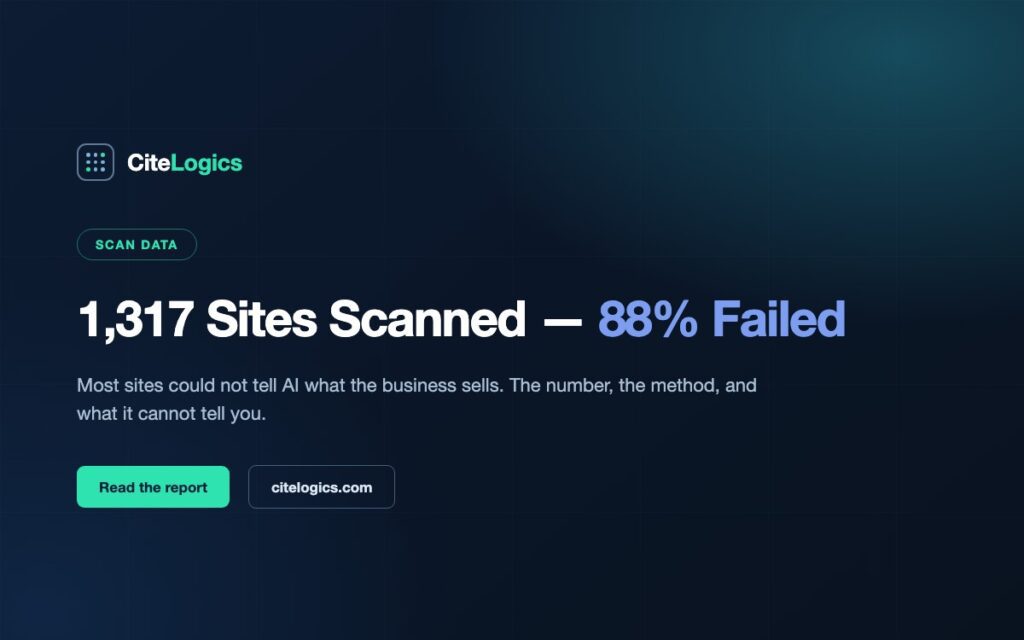
TL;DR: Of 1,317 websites run through our scanner, 1,158 — 88% — gave AI systems no clear signal about what the business actually sells. This figure comes from our own tooling rather than a statistical survey, and it carries limitations you should read before quoting it. This page publishes the number, how it was produced, and what the data cannot tell you.
Limitations, stated first
This section sits at the top rather than buried at the bottom, because a number without context is easy to misuse. Four limitations apply to this dataset.
- Self-selected sample. Every site came from someone who chose to run the scanner. This is not a random sample of Thai websites. People who run a diagnostic usually already suspect a problem, so the failure rate here is probably worse than the true average across all Thai sites.
- Not research. This is a counter attached to a free tool. There is no sampling design and no variable control, and it should not be described as a survey.
- Measured at scan time. Sites fixed afterwards are not reflected. The figure is cumulative across a period, not a snapshot of a single day.
- Measures structure, not outcomes. It says how readable a site is to AI systems. It does not say whether that business gets recommended, which is a separate question.
We previously used a different figure in our communications without tracing it fully, and later found it could not be reconciled with any raw data. We retired that number and now publish only figures that can be traced back. What follows is what survived that cut.
The headline figures
| Measure | Count |
|---|---|
| Websites scanned | 1,317 |
| Sites where AI could not identify what the business sells | 1,158 — 88% |
| Sites passing this check | 159 — 12% |
The test applied: reading the homepage and service pages in the form a bot receives them, can the system state what this business sells and to whom. If that cannot be answered from the text present in the raw HTML, the site fails.
The four most common causes
1. The main content is not in the raw HTML
Sites built on front-end frameworks that render all text through JavaScript hand bots a nearly empty document. The major AI crawlers do not execute JavaScript, so copy that looks perfect on screen does not exist as far as the system is concerned. You can test this in five minutes using the method in can ChatGPT see my website.
2. The homepage sells a feeling, not a product
Lines like “take your business to the next level” or “a partner you can trust” tell a system nothing about what is for sale. Many sites spend the entire first screen on this kind of copy and place the actual product description on a sub-page the bot may never read.
3. No Organization schema, or schema that contradicts the page
Schema lets a system confirm what it inferred from the text. A site with none leaves the model guessing. A site whose schema does not match the visible content creates a conflict in the data, which is worse than having none at all.
4. Business name and contact details disagree across sources
A company name spelled differently on the website, the Google business listing and social profiles makes it harder for a system to conclude these all describe one organisation. That uncertainty reduces the chance of being used in an answer.
What this data cannot tell you
The 88% figure says most sites in this sample are not readable enough for a system to summarise. It does not say:
- what the rate is across all Thai websites, because the sample selected itself
- that sites passing the check will be recommended — structural readiness is necessary but not sufficient. Our own site passes this check and was still not named once across five hiring-intent questions, documented in our self-test
- how much revenue a fix produces, because the distance between being cited and closing a sale depends on many other factors
The number that should drive your decisions is your own site’s, not a group average. Knowing that 88% have a problem does not tell you which group you are in.
Run the same check on your own site
- Fetch your homepage with
curlso no JavaScript executes, then read what actually comes back. - Search that output for product language. If there are no words naming a concrete product or service, the system cannot find them either.
- Read the first 200 words and ask whether someone unfamiliar with the business could state what it sells and to whom.
- Check Organization schema exists and matches the text a visitor can see.
- Compare name and contact details across your website, Google business listing and social profiles for exact consistency.
These five cover the most common failures in the sample. The check takes about an hour and needs no special tooling.
CiteLogics — measure your site, not somebody else’s average
The AI Visibility Audit scores your own site across five AIVS dimensions, identifies exactly where points are lost, and states any ceiling imposed by your current platform. The scoring rubric is published in full.
- AI Visibility Audit — full AIVS Score report plus a 30-minute call. THB 2,000, delivered in 24 hours, 7-day money back.
- Big Win (Audit + WebFix) — audit plus full implementation across crawlability, structure and schema. THB 20,000.
Get your free AI visibility scan, or contact sales@citelogics.com.
Frequently asked questions
Can I cite the 88% figure?
Yes, provided you attribute it fully as data from the CiteLogics scanner across a self-selected sample of 1,317 sites. It should not be presented as a survey of Thai websites generally, because the sample was not randomised.
Why is the figure so high?
Partly sample bias — people who run a diagnostic usually already suspect a problem. Partly because the most common cause is content missing from the raw HTML, which happens on many sites built with modern tooling without the owner ever being aware of it.
If my site passes, will AI recommend me?
Not necessarily. Structural readiness is necessary but not sufficient — you also need an identity that can be corroborated from external sources. Our own site passes this check and was still not named once in hiring-intent questions at our most recent measurement.
What period does this cover?
It is a cumulative total of sites processed by the scanner rather than a single-day snapshot. Sites corrected after being scanned are not reflected. Establishing the current state of any given site requires a fresh scan.
How hard is this to fix?
It depends on the cause. Rewriting a homepage to name the product clearly and adding schema is a matter of days. Content missing from the raw HTML may require changing how the site renders, which is a matter of weeks, and some platforms impose a ceiling that cannot be removed at all.

Written by
Nipun Kasevayuth
Founder & CTO, CiteLogics
An engineer and AI enthusiast who reverse-engineers how AI models decide which brands to cite. He proved the method on his own websites first — then delivered the same results for brands like Coldtubb. He and the CiteLogics team have scanned 1,000+ websites for AI visibility.
Connect on LinkedIn →