← Part of the full guide: Why AI Doesn’t Recommend Your Brand
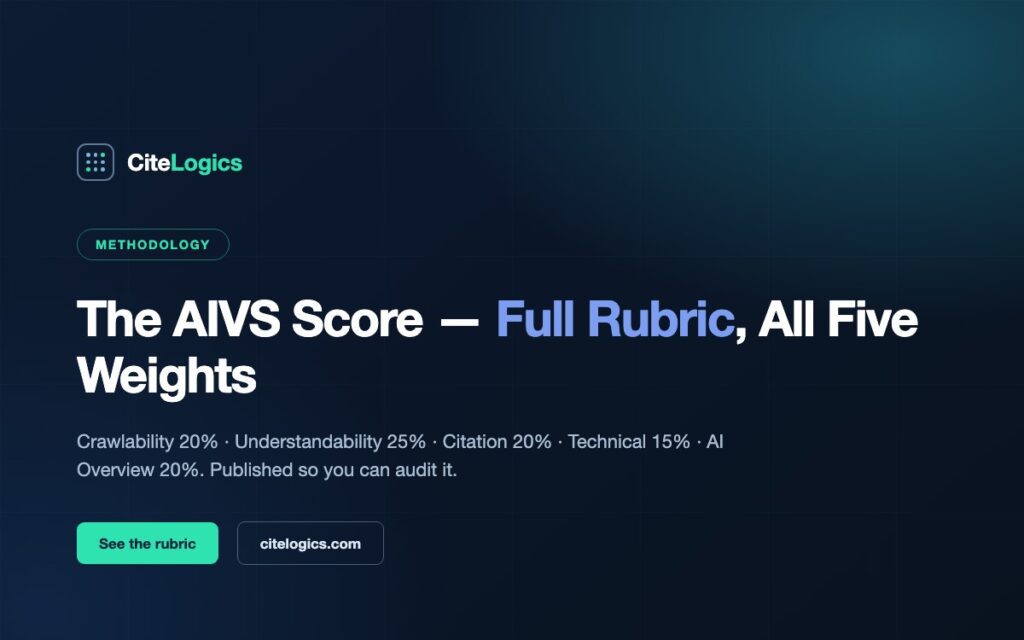
TL;DR: The AIVS Score is a 0–100 measure of how structurally ready a site is to be cited by AI systems. It is built from five weighted dimensions — Crawlability 20%, Content Understandability 25%, AI Citation Presence 20%, Technical Performance 15%, AI Overview Presence 20%. This page publishes the entire rubric, the weights, two real client before-and-after breakdowns, and an explanation of why some sites have a ceiling they cannot pass.
Why publish the rubric
A score whose calculation cannot be inspected is a marketing number. We publish the full rubric so clients can audit our work, and so people who never hire us can score their own site. If someone follows the method and gets a different result from our report, that is a discrepancy we have to explain.
The second reason is a limitation worth stating plainly. AIVS does not predict that AI will recommend you — nobody can guarantee that. It measures structural readiness, which is necessary but not sufficient. A site can score well and still never be surfaced if the business cannot be corroborated externally. Our own case is documented in the self-test where we scored zero.
The five dimensions and their weights
| Dimension | What it measures | Weight |
|---|---|---|
| 01 Crawlability | Whether AI bots can reach the site — robots.txt, sitemap, llms.txt, canonical tags | 20% |
| 02 Content Understandability | Whether a model can tell who you are and what you sell — schema, JSON-LD, heading hierarchy, FAQ structure | 25% |
| 03 AI Citation Presence | Whether AI actually mentions you — 25+ fixed queries across ChatGPT, Claude, Perplexity and Gemini | 20% |
| 04 Technical Performance | Page speed, mobile readiness, SSL, structured data validation | 15% |
| 05 AI Overview Presence | Google AI Overview readiness and featured snippet positioning | 20% |
Each dimension is scored 0–100 and then weighted. A site scoring Crawlability 80, Content 60, Citation 40, Technical 70 and AI Overview 50 lands at (80×0.20)+(60×0.25)+(40×0.20)+(70×0.15)+(50×0.20) = 59.5
Why the weights sit where they do
Content Understandability carries the most at 25%
It is the dimension that moves furthest under work you fully control, and the one most commonly failed. Across 1,317 Thai sites scanned with our tool, 88% gave AI systems no clear signal about what the business actually sells. That figure comes from our own tooling rather than a statistical survey.
Crawlability and AI Overview Presence both carry 20%
Crawlability is a gate — fail it and nothing else counts, because the bot never reads the page. AI Overview Presence carries equal weight because it is the most-seen surface in Thailand, sitting directly on the Google results page that most Thai users still start from.
AI Citation Presence carries 20% despite being the real outcome
It is the only dimension measuring results rather than readiness, but it is not weighted higher because output varies with session state and inferred location. Weighting it too heavily would make the total unstable enough to break month-to-month comparison.
Technical Performance carries the least at 15%
Page speed matters more to human visitors than to crawlers, which tolerate slow pages better than people do. It is weighted below the dimensions that bear directly on whether a page gets cited.
Two real before-and-after breakdowns
Bodymap TH — WB-EMS studio, Bangkok
Total 38 to 72. Grade D to C+. Plus 34 points over 8 days, 11 of 11 tickets shipped, zero schema errors.
| Dimension | Before | After | Change |
|---|---|---|---|
| Crawlability | 69 | 82 | +13 |
| Content Understandability | 30 | 74 | +44 |
| AI Citation Presence | 30 | 65 | +35 |
| Technical Performance | 58 | 82 | +24 |
| AI Overview Presence | 28 | 68 | +40 |
Measured side effects in week one: page views 10 to 43, AI bot crawls 130 to 258, and the first ChatGPT referral session arriving in the same week.
The ceiling we disclosed up front: 72 is the practical maximum on this Wix SPA build, where the HTML-to-code ratio sits at 6.75%. Migrating to WordPress or Next.js would unlock the 82–88 range. A client not told this in advance will keep paying to chase points the platform will never allow.
Coldtubb — cold plunge brand, Thailand
Total 37 to 55. Grade D to C. Plus 18 points, also limited by a CMS ceiling.
| Dimension | Before | After | Change |
|---|---|---|---|
| Crawlability | 64 | 71 | +7 |
| Content Understandability | 19 | 48 | +29 |
| AI Citation Presence | 25 | 65 | +40 |
| Technical Performance | 46 | 50 | +4 |
| AI Overview Presence | 0 | 40 | +40 |
Traffic, March against April: sessions 64 to 198, engaged sessions 35 to 115, referral traffic 3 to 22, and a new Organic Social channel at 44.
On Friday 9 May, the secretary to a five-star hotel general manager in Chiang Mai called for a quote, saying ChatGPT had recommended Coldtubb.
How to read a score
The total gives you the shape; the decisions live at dimension level. Comparing the two cases above, Coldtubb sits 17 points below Bodymap overall, yet both reach 65 on AI Citation Presence — the citation work performed comparably. What dragged the total was Technical Performance, which moved only 4 points against a CMS constraint.
Read a report in this order. First, which dimensions sit below 50 — that is where effort buys the most points. Second, which dimensions have a platform ceiling — never spend budget chasing points the platform will not permit. Third, whether Crawlability passes at all, because if it does not, the other four barely matter.
Score your own site roughly
- Crawlability — fetch your main pages with
curlusing an AI bot user agent and confirm your copy is present in the raw HTML. Check robots.txt is not blocking bots you want, and that your sitemap actually resolves. - Content Understandability — read the first 200 words of your service page and ask whether they establish what you sell and to whom. Then confirm Organization schema and any FAQ markup match the text a visitor can actually see.
- AI Citation Presence — run at least 25 buying-intent questions across several platforms and count the share of answers naming you.
- Technical Performance — measure page speed and mobile readiness, then validate structured data with Google’s testing tool and confirm no outstanding errors.
- AI Overview Presence — search your category’s main questions on Google and record whether an AI Overview appears and which sources it cites.
This gives numbers rough enough to prioritise work. Producing a score comparable against competitors requires a fixed question set re-run under identical conditions each month.
CiteLogics — a score you can audit
The AI Visibility Audit returns all five AIVS dimensions with the specific deductions behind each, and identifies any ceiling imposed by your current platform so budget goes where it can actually move the number.
- AI Visibility Audit — full AIVS Score report plus a 30-minute call. THB 2,000, delivered in 24 hours, 7-day money back.
- Big Win (Audit + WebFix) — audit plus full implementation across crawlability, structure and schema. THB 20,000.
Get your free AI visibility scan, or contact sales@citelogics.com.
Frequently asked questions
Does a high AIVS score guarantee AI will recommend me?
No. AIVS measures structural readiness, which is necessary but not sufficient. A site can score well and still be passed over if the business cannot be corroborated from sources it does not own. Nobody can guarantee outcomes inside AI systems.
Why do some sites have a score ceiling?
Some site builders limit how much raw HTML and structured data you control. The Bodymap case topped out at 72 because the HTML ratio on that Wix SPA build was 6.75%. Knowing the ceiling first prevents spending budget chasing points the platform will not allow.
What counts as a good score?
A single number means less than the comparison against competitors in your category and against your own figure last month. Start with any dimension below 50, since that is where effort produces the largest movement per unit of work.
How many queries go into AI Citation Presence?
At least 25 per business, run across ChatGPT, Claude, Perplexity and Gemini. The wording must stay fixed between measurement rounds, because changing questions mid-way makes month-to-month comparison meaningless.
What if my own calculation disagrees with your report?
Send us your figures with the date you measured. Differences usually trace to a different question set or a different measurement window. If the discrepancy turns out to be our error, we correct the report and explain what went wrong.

Written by
Nipun Kasevayuth
Founder & CTO, CiteLogics
An engineer and AI enthusiast who reverse-engineers how AI models decide which brands to cite. He proved the method on his own websites first — then delivered the same results for brands like Coldtubb. He and the CiteLogics team have scanned 1,000+ websites for AI visibility.
Connect on LinkedIn →